8 AI Strategies for Higher Ed Enrollment (2026)
Enrollment teams at colleges and universities are fielding more inquiries, managing longer recruitment cycles, and competing for a shrinking pool of prospective students. AI is already helping institutions address those pressures, but knowing where to start can be the hardest part. Stratagon partners with higher education teams to connect AI tools with the enrollment workflows that matter most, from first inquiry through paid deposit.
This article walks through the practical ways AI can support personalized student engagement across your recruitment and enrollment operations. Each section focuses on a specific use case you can evaluate, pilot, or scale within your existing technology stack.
Key Takeaways: AI for Personalized Student Engagement
- AI-driven lead scoring helps admissions teams prioritize prospective students who are most likely to enroll.
- Automated nurture sequences personalize outreach at scale without adding headcount to your already stretched enrollment office.
- Predictive analytics identify at-risk applicants early in the funnel so counselors can intervene before enrollment yield drops.
- Stratagon helps institutions integrate AI into existing CRM platforms like HubSpot for measurable enrollment gains.
- Video-based AI agents provide around-the-clock student engagement that matches your institution's unique voice, brand, and timelines.
How AI Supports Personalized Engagement Across the Enrollment Funnel
1. AI-Powered Lead Scoring for Smarter Prospect Prioritization
Your admissions team likely receives thousands of inquiries each cycle. AI-powered lead scoring models analyze behavioral signals, such as email opens, page visits, and event attendance, to assign each prospective student a likelihood-to-enroll score.
That score lets counselors focus their time on the students who need a personal conversation rather than spending equal effort on every name in the database. Institutions using predictive lead scoring have reported enrollment increases of up to 15%, according to the UPCEA and EducationDynamics AI Readiness Report (2025).
2. Personalized Nurture Sequences That Scale Without Extra Staff
Generic email blasts are losing effectiveness. According to a 2026 Capture Higher Ed survey, 83% of prospective students are more likely to take the next step when outreach feels personalized, and nearly 60% say generic messaging makes them less interested in an institution.
AI-driven marketing automation lets you build nurture sequences that adjust content based on a prospect's declared interests, browsing behavior, and stage in the enrollment funnel. A prospective nursing student receives information about clinical placements and licensure pathways, while an engineering prospect sees content about lab facilities and co-op opportunities.
3. Predictive Analytics for Enrollment Yield Improvement
One of the most persistent challenges in enrollment management is predicting which admitted students will actually enroll. Machine learning models analyze application data, engagement patterns, geographic information, and communication response rates to assign each admitted student an enrollment probability score.
Georgia State University demonstrated the value of this approach with its AI-driven chatbot initiative. The system engaged incoming students throughout the summer, reducing "summer melt" by more than 22% within the first year. Your team can use similar probability scores to focus yield efforts on admitted students who are genuinely interested but have not yet committed.
4. AI Chatbots and Virtual Assistants for Around-the-Clock Support
Prospective students research institutions on their own schedule, often outside business hours. AI-powered chatbots and virtual assistants deployed on your website can answer common questions about applications, financial aid, campus housing, and program details without requiring staff to be available at midnight.
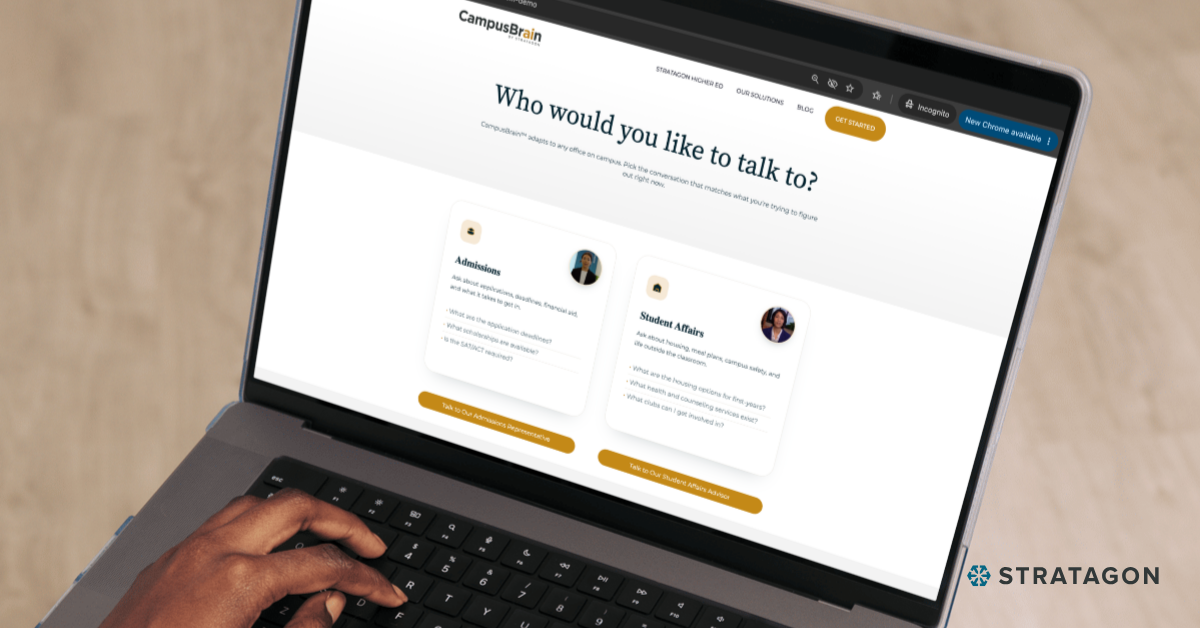
Stratagon built CampusBrain™, a video-based AI agent designed specifically for higher education. CampusBrain™ delivers personalized visual narratives aligned with your institution's enrollment timelines, engaging prospective students when they raise a hand without requiring your team to be in the office.
5. CRM Integration That Connects Your Entire Recruitment Funnel
AI tools produce the strongest results when they feed data back into a unified CRM. Admissions CRM platforms like HubSpot allow enrollment teams to track every interaction, from the first website visit through application, acceptance, and deposit, in one place.
When AI-generated lead scores, chatbot transcripts, and engagement data live inside a single student lifecycle system, your counselors see a complete picture of each prospect. That visibility helps teams make faster, more informed decisions about where to invest their outreach energy and which students need a direct conversation.
6. Automated Application Follow-Up to Reduce Incomplete Submissions
Incomplete applications represent one of the largest sources of lost enrollment revenue. AI systems integrated within your CRM can monitor each applicant's progress in real time, flagging missing documents and triggering personalized reminders well before deadlines pass.
These automated follow-up workflows reduce the administrative burden on your admissions staff and keep applicants moving forward through every required step. Institutions that have implemented AI-assisted application tracking have seen completion rates improve by approximately 30%, freeing counselors to focus on relationship-building and yield conversations rather than chasing paperwork.
7. Data-Informed Recruitment Strategy and Channel Optimization
Traditional recruitment workflows often rely on historical patterns rather than real-time performance data. AI analytics platforms evaluate which recruitment channels, messages, and geographic regions generate the highest-quality inquiries and the strongest inquiry-to-application conversion rates.
This allows your team to reallocate budget toward the channels that drive enrolled students rather than simply generating form fills. Stratagon helps institutions build digital transformation strategies that connect recruitment analytics directly to enrollment outcomes, giving your leadership a clear view of return on marketing investment.
8. AI-Powered Retention Alerts to Protect Your Enrolled Class
Student engagement does not end at deposit. AI-powered retention systems analyze signals like learning management system activity, advising appointment attendance, course performance trends, and financial aid status to identify students who may be at risk of disengaging before they actually leave.
Early-alert workflows notify advisors and support staff so they can intervene with timely, targeted outreach. HubSpot-based retention workflows allow institutions to automate that outreach to at-risk students while preserving the personal connection that keeps students on track to graduation.
How to Evaluate AI Readiness on Your Campus
Adopting AI for enrollment does not require replacing your existing systems overnight. Start by assessing your current data infrastructure and the specific enrollment challenges where automation can deliver the fastest measurable impact.
A 2025 report from UPCEA found that 78% of organizations now use AI in at least one operational function, yet a gap persists between institutional optimism and actual readiness. Stratagon works with enrollment teams to audit existing technology, identify gaps, and build a phased implementation roadmap that connects AI tools to the metrics your leadership team tracks most closely.
FAQs About AI for Higher Education Enrollment
What types of AI are most useful for enrollment management?
Predictive lead scoring, automated nurture sequences, and AI chatbots deliver the most immediate impact on enrollment. These tools help admissions teams prioritize outreach, personalize communication at scale, and provide around-the-clock support to prospective students.
Does AI replace the work of admissions counselors?
No. AI handles repetitive, high-volume tasks like answering frequently asked questions and flagging incomplete applications. This frees your counselors to focus on the personal conversations and relationship-building that influence enrollment decisions.
How does Stratagon help institutions implement AI for enrollment?
Stratagon partners with enrollment teams to integrate AI tools into existing CRM platforms like HubSpot. Services include lead scoring configuration, marketing automation setup, CampusBrain™ deployment, and ongoing performance measurement tied to enrollment outcomes.
What CRM platforms work with AI enrollment tools?
HubSpot is one of the most widely used CRM platforms in higher education for AI-powered enrollment. It supports lead scoring, automated workflows, chatbot integration, and full student lifecycle tracking within a single system.
How long does it take to see results from AI in enrollment?
Many institutions see measurable improvements within the first enrollment cycle after implementation. Early wins typically come from automated follow-up sequences and lead scoring, which can increase counselor efficiency and reduce response times within weeks of going live.
Is AI appropriate for smaller institutions with limited budgets?
Yes. AI tools often reduce the need for additional headcount by automating time-intensive tasks. A phased implementation approach, starting with a single high-impact use case like chatbot support or lead scoring, allows smaller institutions to see value before expanding.