How to Implement AI Lead Scoring for Admissions in 2026
Higher education institutions are under increasing pressure to improve enrollment yield while managing growing volumes of prospective student inquiries across multiple channels.
Traditional admissions models often rely on static scoring methods, manual segmentation, and delayed follow up processes that make it difficult to identify high intent applicants early enough to influence enrollment decisions effectively.
In 2026, institutions are increasingly turning to AI powered lead scoring and automated outreach systems to improve recruitment efficiency, prioritize high value prospects, and create more personalized student engagement journeys.
For admissions and enrollment marketing leaders, the opportunity is no longer simply automating communication. The real advantage comes from using AI to improve decision making across the entire recruitment funnel.
This guide explains how institutions can implement AI powered lead scoring and segmented outreach using platforms like CampusBrain and HubSpot Customer Agent to improve enrollment outcomes and operational efficiency.
Why Traditional Admissions Lead Scoring No Longer Works
Many institutions still rely on manual scoring frameworks based on limited criteria such as inquiry forms, academic performance, or event attendance.
While these systems provide some structure, they often fail to account for real time engagement behavior and evolving student intent signals.
As a result, admissions teams frequently encounter problems such as:
- delayed follow up,
- poor prioritization of high intent students,
- inconsistent communication workflows,
- low conversion visibility,
- and inefficient counselor allocation.
AI powered lead scoring addresses these challenges by continuously analyzing behavioral, demographic, and engagement data to identify which students are most likely to apply, enroll, or disengage.
Instead of static lead categories, admissions teams gain dynamic scoring models that evolve as student behavior changes throughout the recruitment journey.
Step 1: Centralize Student Recruitment Data
The foundation of effective AI implementation services for higher education enrollment is data consolidation.
Before AI models can generate accurate lead scores, institutions must unify recruitment data across:
- CRM platforms,
- inquiry forms,
- website interactions,
- email engagement,
- event registrations,
- application systems,
- chatbot interactions,
- and student communication platforms.
This is where platforms like HubSpot Customer Agent become especially valuable.
HubSpot Customer Agent helps institutions centralize engagement data while automating communication tracking across the student recruitment funnel. Instead of operating from disconnected systems, admissions teams gain a unified view of prospective student behavior.
CampusBrain further enhances this process by integrating AI powered engagement analysis and conversational intelligence into the recruitment workflow.
When admissions teams have access to centralized behavioral data, AI models can generate significantly more accurate enrollment predictions.
Step 2: Define Enrollment Intent Signals
AI lead scoring works best when institutions clearly define the behavioral signals that indicate enrollment intent.
Rather than relying only on academic metrics, modern AI solutions for college enrollment evaluate how prospective students interact with institutional content and admissions processes over time.
Common high intent signals include:
- repeated program page visits,
- financial aid inquiries,
- application starts,
- webinar attendance,
- campus tour registrations,
- chatbot engagement,
- email click behavior,
- and response times to outreach.
CampusBrain can help identify and prioritize these engagement patterns automatically by analyzing behavioral activity across digital recruitment channels.
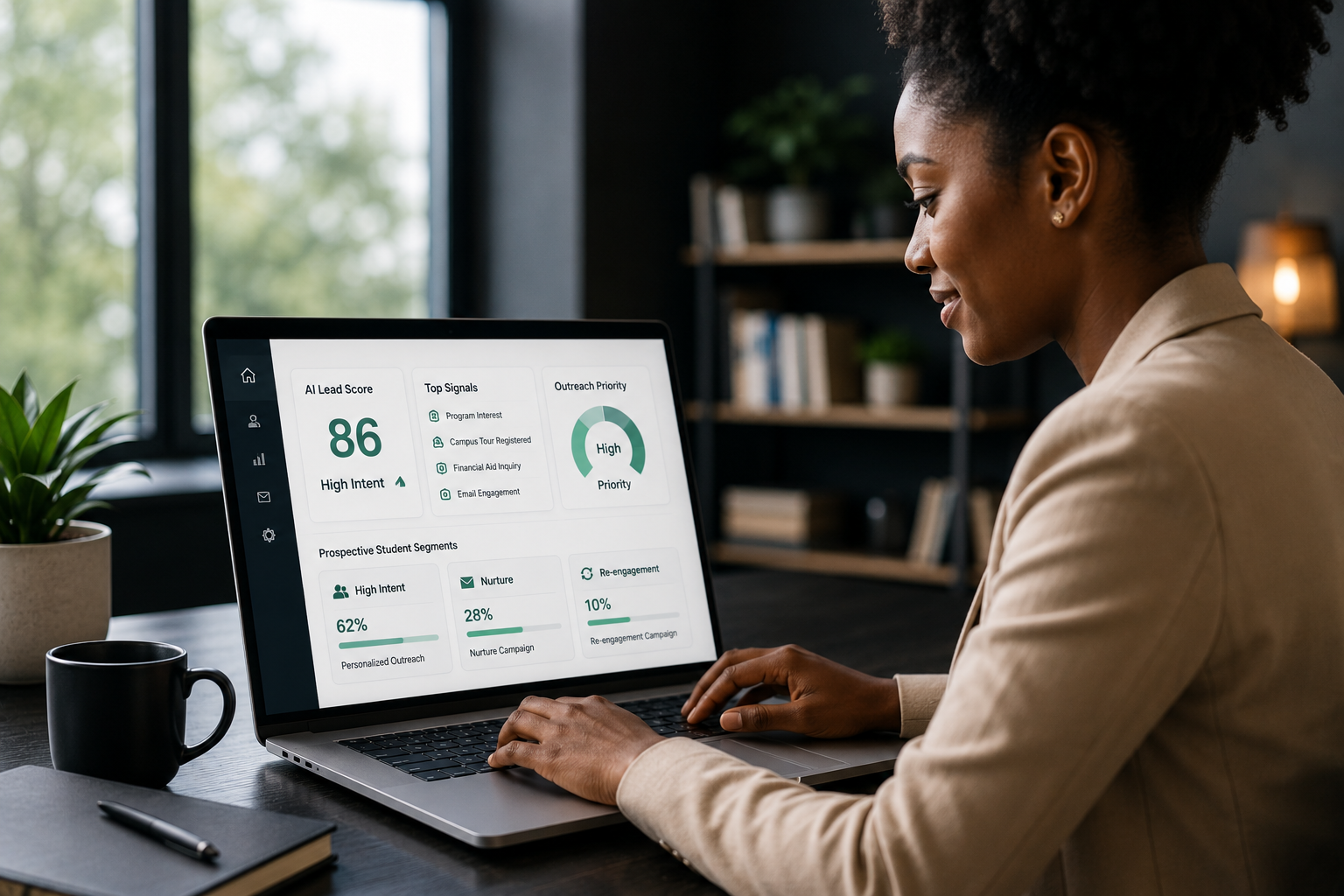
For example, a student who repeatedly interacts with scholarship information, engages with admissions chat workflows, and revisits program pages multiple times within a short period may receive a significantly higher lead score than a passive inquiry contact.
This allows admissions teams to focus counselor outreach where it is most likely to influence enrollment decisions.
Step 3: Implement Dynamic AI Lead Scoring Models
Traditional scoring systems often remain static throughout the recruitment cycle. AI driven enrollment systems continuously update scores in real time based on changing engagement patterns.
Using CampusBrain alongside HubSpot Customer Agent, institutions can build dynamic scoring models that evaluate:
- engagement frequency,
- communication responsiveness,
- application progression,
- content consumption,
- geographic trends,
- academic fit,
- and likelihood to enroll.
Instead of assigning fixed values manually, AI models continuously learn from historical admissions outcomes and recruitment behavior.
For example, the system may identify that students engaging with financial aid calculators and attending virtual information sessions within the same week historically convert at a significantly higher rate.
AI then automatically increases prioritization for similar prospects moving forward.
This creates more data driven enrollment decision making while reducing manual scoring inconsistencies.
Step 4: Segment Prospective Students Automatically
Once lead scoring is implemented, the next step is segmented outreach automation.
Many institutions still rely on broad communication campaigns that treat all prospective students similarly regardless of intent level or engagement behavior.
AI powered segmentation changes this by automatically grouping students based on:
- enrollment likelihood,
- academic interest,
- engagement stage,
- communication preferences,
- geographic location,
- and behavioral activity.
HubSpot Customer Agent enables automated workflow personalization across email, chat, and follow up communication channels, while CampusBrain enhances segmentation through conversational AI insights and behavioral engagement analysis.
For example:
- high intent applicants can receive accelerated counselor outreach,
- undecided prospects can receive nurture campaigns,
- and disengaged students can trigger re engagement workflows automatically.
This creates more relevant communication experiences while improving admissions team efficiency.
Step 5: Automate Personalized Student Outreach
One of the biggest operational advantages of student recruitment and admissions AI is the ability to automate personalized engagement at scale.
AI powered outreach systems can personalize:
- email timing,
- communication cadence,
- content recommendations,
- chatbot responses,
- and follow up workflows based on individual student behavior.
Instead of generic campaign messaging, institutions can deliver highly relevant communication experiences tailored to each prospective student's stage in the enrollment journey.
CampusBrain plays a particularly important role here by enabling AI powered conversational engagement across recruitment channels.
Students can receive immediate responses to admissions questions, program inquiries, application guidance, and enrollment support without waiting for counselor availability.
Meanwhile, HubSpot Customer Agent helps coordinate communication workflows across the CRM ecosystem to ensure continuity throughout the recruitment process.
This combination improves response speed, engagement consistency, and overall recruitment efficiency.
Step 6: Measure Enrollment Yield and Model Accuracy
AI implementation should always be tied to measurable enrollment outcomes.
Institutions should continuously evaluate:
- enrollment yield rates,
- inquiry to application conversion,
- application completion rates,
- counselor response times,
- engagement performance,
- and AI scoring accuracy.
By analyzing which lead scoring factors correlate most strongly with actual enrollment behavior, institutions can refine models continuously over time.
CampusBrain and HubSpot Customer Agent provide operational visibility into engagement patterns and recruitment performance, allowing admissions leadership to optimize workflows based on real student outcomes rather than assumptions.
This creates a continuous improvement cycle where AI systems become more accurate as more recruitment data becomes available.
Why AI Lead Scoring Matters in 2026
Higher education recruitment environments are becoming increasingly competitive, data driven, and digitally influenced.
Institutions that continue relying on manual recruitment processes and static lead prioritization models will struggle to maintain enrollment efficiency at scale.
AI implementation services for higher education enrollment are becoming essential because they allow admissions teams to:
- prioritize high intent students faster,
- personalize communication at scale,
- improve counselor efficiency,
- reduce recruitment friction,
- and optimize enrollment yield using real time behavioral intelligence.
The institutions seeing the strongest enrollment performance improvements are not simply deploying AI tools. They are integrating AI directly into recruitment operations, communication workflows, and enrollment decision making processes.
Platforms like CampusBrain and HubSpot Customer Agent are helping institutions move beyond basic automation toward intelligent, predictive enrollment ecosystems designed to improve both operational efficiency and student engagement.
In 2026, the future of enrollment growth will increasingly depend on how effectively institutions combine AI powered engagement, behavioral intelligence, and data driven admissions strategy into a unified recruitment experience.